

PRODUCT OVERVIEW
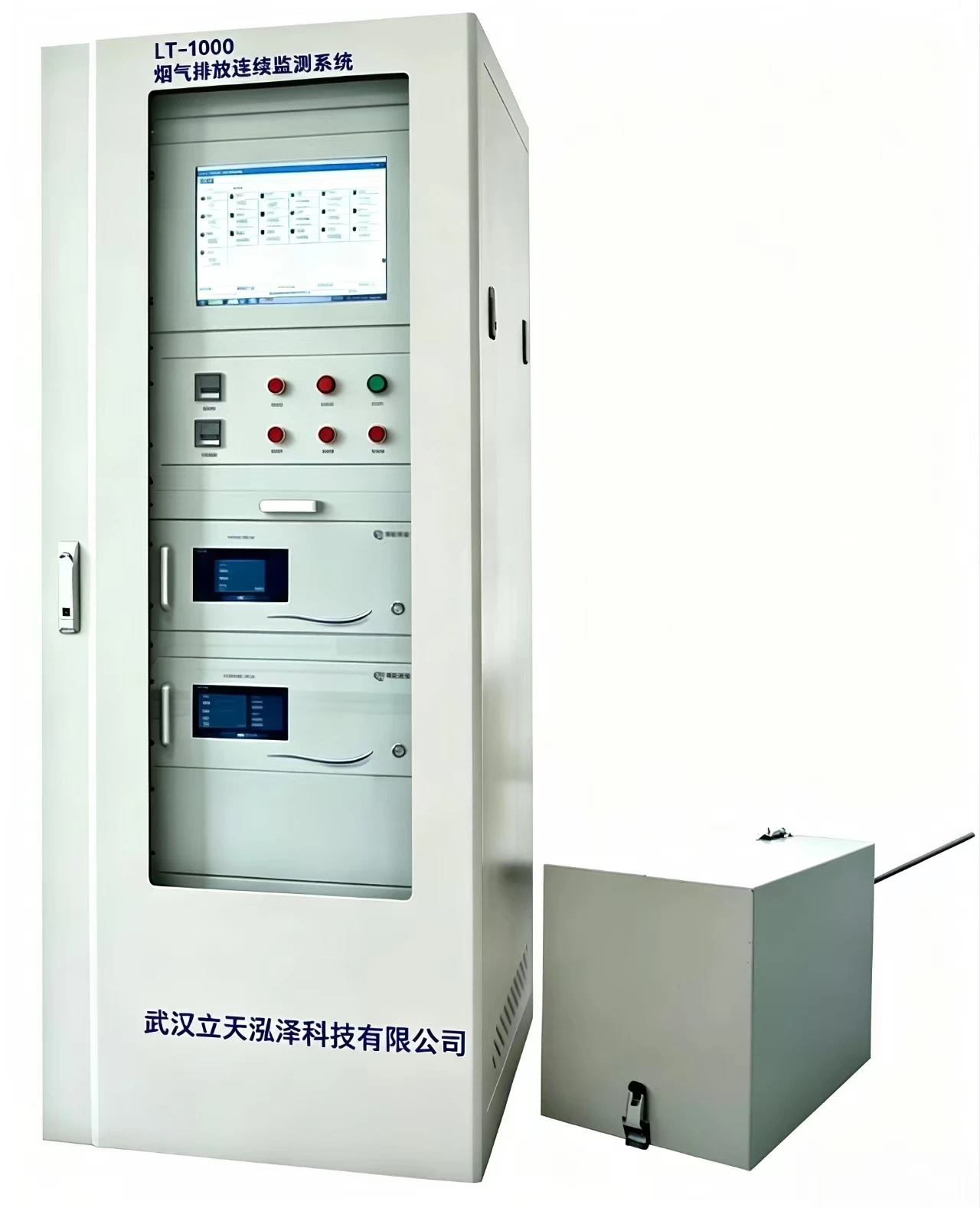
LT-1000-Hg flue gas mercury continuous monitoring system is a device that continuously monitors the concentration and total emission
of gaseous mercury from atmospheric pollution sources and transmits the data to the regulatory authorities in real time.
It can continuously and in real time track and measure the concentrations ofHg andHg2+ (mg/m3) and emission rates (kg/h, t/d and t/a) in the flue gas emitted from stationary pollution sources (such as boilers, industrial furnaces and incinerators).
The flue gas mercury continuous monitoring system independently developed by our company adopts the advanced dilutionextraction method +cold vapor atomic fluorescence technique.
It can measure Hg,Hg2+,O2, temperature, pressure, flow rate, humidity and many other parameters. All monitoring
parameters can be transmitted to the user DCS system, and the system communicates with the environmental authority data system via a data logger. The system equipment is installed
in an analyzer shelter, and is easy to operate and maintain; the whole system features a simple structure, modular design, high stability and low operating cost.
TECHNICAL PARAMETER
| Measurement Items | Hg, Hg2+, O2, temperature, pressure, flow rate,humidity; |
| Flue Gas Sampling Method | Dilution Extraction Method |
| Hg Measurement Method | Cold Vapor Atomic Fluorescence Method |
| O2 Measurement Method | Zirconia |
| Measurement Methods for Temperature, Pressure, Flow and Humidity | Temperature:thermistor; Pressure:pressure sensor; Flow:differential pressure method; Humidity: limiting current |
| Mercury Measurement Principle | Cold Vapor Atomic Fluorescence Method |
| Range | 0~5ug/m3~200ug/m3 |
| Indication Error | No more than ±5% |
| Repeatability | ≤1% |
| Zero Drift | No more than ±1% F.S. |
| Span Drift | No more than ±1% F.S. |
| Operating Temperature | -20°C ~ 50°C |
PRODUCT FEATURES
●Adopts advanced atomic fluorescence analysis technology with a low detection limit, stable and reliable system design and small long-term drift;
● Mercury speciation converter efficiency≥95%;
●Strong anti-interference capability,unaffected by particulates, moisture and other factors;
●The core measurement unithas no optical moving parts and offers high reliability;
● Sampling probe with an all-SUS304 designto avoid mercury adsorption and acid corrosion;
● Precisedilution ratiocontrol technology,reflecting the true measuredHg concentration.
APPLICATION AREA
Application areas cover thermal power generation,non-ferrous metallurgy, cement industry, waste incineration,hazardous waste incineration,petrochemical industry, etc.
Why Choose Our Flue-Gas Mercury CEMS
High-accuracy total mercury measurement with strong resistance to flue-gas matrix interference Stable detection for elemental & divalent mercury; high-efficiency thermal conversion minimizes measurement drift caused by SO₂ and dust.
Full-heated sampling system to minimize mercury adsorption loss Fully heated sampling lines prevent condensation and mercury loss, reflecting real stack emission levels.
Modular design with low-cost routine maintenance Easy-to-replace key modules and auto-back-flush function reduce service workload for power plants and waste-to-energy plants.
Flexible data output compatible with various control systems 4-20mA, RS485 and TCP/IP interfaces available for DCS, SCADA and environmental reporting platforms.
Compliant with major international environmental standards with local-adaptable options. Meets HJ, EN and other relevant standards; customized measuring range and complete test documents for site acceptance.
FAQ
Q: Can the mercury monitoring system directly measure divalent mercury in flue gas?
A: No. A thermal converter is needed for mercury species conversion before measurement.
Q: How to calibrate the system with mercury calibration gas?
A: Mercury permeation tube is used to generate standard mercury vapor for zero span calibration.
Q: Will SO₂ in flue gas interfere with mercury measurement results?
A: Yes. An interference elimination unit shall be equipped to reduce sulfide impact.
Q: Why is heating required for the sampling line?
A: To avoid adsorption and condensation of mercury compounds and prevent mercury loss.
Q: What comparison tests are required for system acceptance?
A: Conduct reference comparison test against manual method HJ 543 to verify data consistency.
Hot Tags: flue gas mercury online monitoring system lt-1000-hg, China flue gas mercury online monitoring system lt-1000-hg manufacturers, suppliers, factory, Carbon monoxide online monitoring system, CEMS Analyzer, Chemical reaction kettle oxygen online analysis system , Online monitoring of oxygen content in pharmaceutical centrifuge, Online monitoring system for ammonia escape concentration, Online monitoring system for carbon monoxide in coal mill silos


